
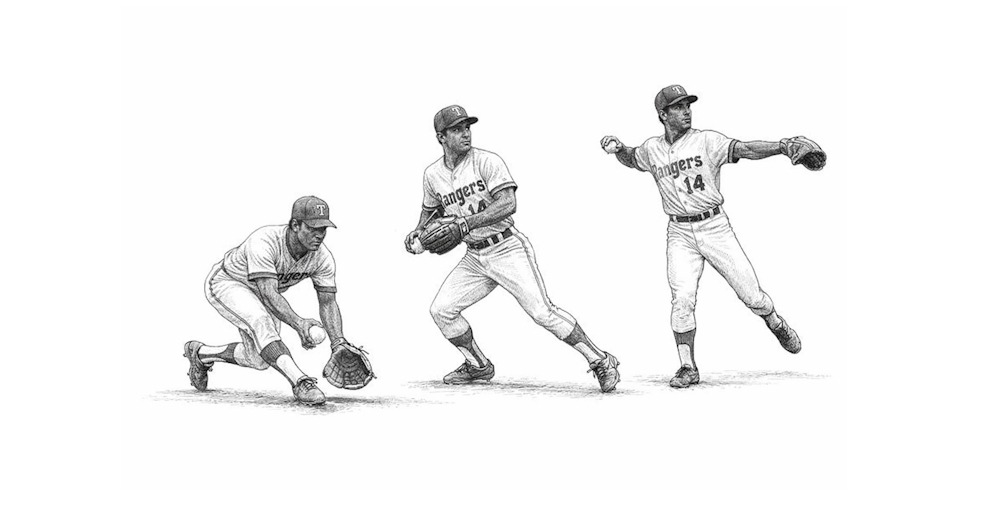
Franco’s Three
May 1, 1991 | No-hitter #7
Julio Franco and the Edges of History
On May 1, 1991, at Arlington Stadium, Nolan Ryan did what no pitcher had ever done—he threw his seventh no-hitter. The box score tells a familiar story: 27 outs, 16 strikeouts, no hits.
It reads like dominance, the kind that seems complete and unquestioned. But the box score does not tell you how close history came to slipping through the infield grass, and it does not tell you about Julio Franco.
Ryan’s 16 strikeouts were overwhelming, especially in an era when such totals were far from routine. Yet even on a night like that, not every out belonged to him. Eleven balls were put into play, each one a moment where the outcome no longer rested in his hand. A no-hitter, for all its mythology, is never built on strikeouts alone. It lives in those quieter moments, when the ball leaves the bat and the burden shifts elsewhere.
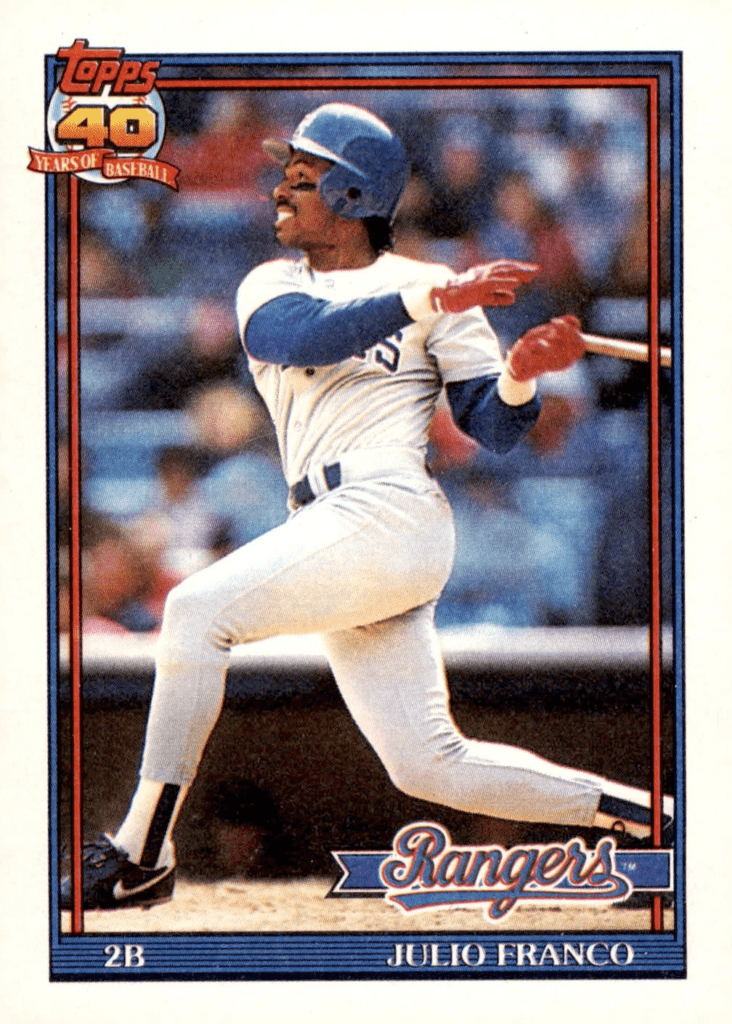
By then, Julio Franco was far from an anonymous figure. He had already established himself as one of the American League’s most disciplined hitters, a batting champion whose .341 season in 1990 reflected an approach rooted in precision rather than power. His distinctive stance made him recognizable, but it was his control—of the strike zone, of the bat, of the moment—that defined him. He was a player who did not give away at-bats, who understood timing and contact in a way that made him quietly indispensable.
That same steadiness carried into the field. Franco was not known as a defensive standout, but he was reliable in the ways that matter most—positioned well, fundamentally sound, and consistent. He made the routine plays routinely, and he made them without hesitation. For pitchers, that kind of presence becomes an unspoken trust, the assurance that when the ball is put in play, it will be handled.
On that night, Franco was part of three of those eleven chances. Each one was a small test of the no-hitter’s survival, the kind that rarely draws attention but always carries consequence. There were no diving stops or dramatic flourishes—just clean fielding, proper positioning, and execution. The kinds of plays that disappear into the flow of the game, even as they quietly preserve it.
We tend to remember Ryan alone—his fastball, his endurance, his defiance of time. But a no-hitter is a fragile structure, dependent on every completed out. Remove just one of those plays, just one ground ball that finds its way through, and the meaning of the night changes. The record remains impressive, but it is no longer singular.
Franco’s role is a reminder of something easily overlooked: a no-hitter is not simply the absence of hits, but the accumulation of outs. Each one must be secured, and many are shared. Even in a game defined by strikeouts, nearly half the work belonged to someone else.
If even one of those balls gets through—if Franco is a step late, or the hop is uneven—we are not talking about seven. We are talking about six, and something that almost was.